Concrete Versus Asphalt Parking Lots Compared
Concrete versus asphalt parking lots: compare cost, lifespan, drainage, repairs, and traffic needs before choosing the right surface for your property.
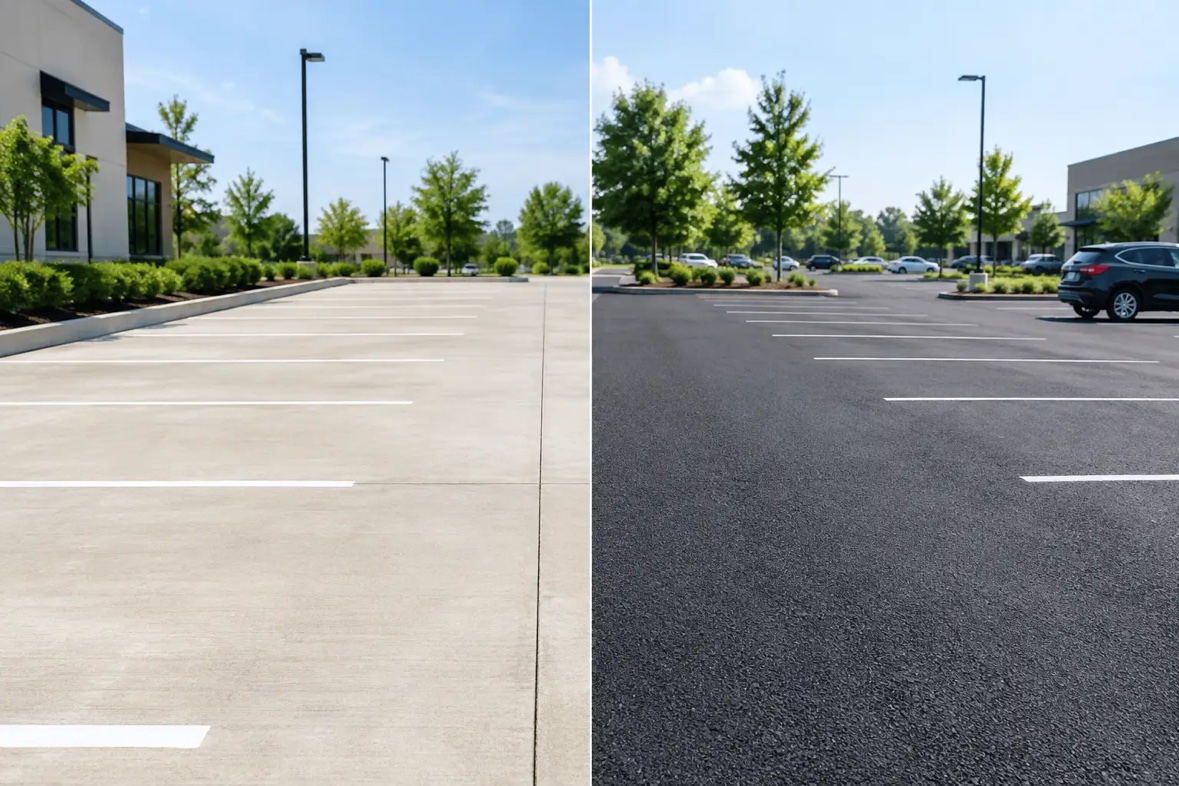
A parking lot can look acceptable on opening day and still fail early because the base was weak, water had nowhere to go, or the pavement was not designed for the traffic it carries. When comparing concrete versus asphalt parking lots, the material matters, but the construction underneath it matters just as much. Property owners in Southern California need a surface that handles daily vehicles, heat, delivery traffic, and drainage without becoming a constant repair item.
The right choice depends on your budget, expected traffic, maintenance plan, and how long you intend to own the property. Concrete usually costs more upfront but provides a longer service life and greater resistance to heavy loads. Asphalt typically costs less to install and can be repaired quickly, but it needs regular attention to keep water, heat, and oxidation from breaking it down.
Concrete Versus Asphalt Parking Lots: The Main Difference
Concrete is a rigid pavement. It spreads vehicle loads across a wider area, which makes it well suited for entry lanes, dumpster pads, loading areas, and lots that see frequent delivery trucks. A properly installed concrete parking lot is built on a compacted base, placed at the correct thickness, reinforced where needed, jointed to control cracking, and graded to drain.
Asphalt is a flexible pavement. It has some give under traffic and is commonly used for larger lots where initial budget is the main concern. Its performance relies heavily on a stable, well-compacted aggregate base and good drainage. Without those, asphalt can develop alligator cracking, rutting, potholes, and low areas where water sits.
Neither material can overcome poor site preparation. A thin slab over soft soil will crack. Fresh asphalt over an unstable base will move and fail. The visible surface is only the top layer of the job.
Upfront Cost Versus Long-Term Cost
Asphalt generally has the lower initial installation cost, especially on a large, open parking area. It is fast to place, and businesses may be able to reopen sooner depending on the project scope and curing requirements. That can make asphalt appealing for owners managing a tight capital budget.
Concrete requires a larger investment at the start. It needs more formwork, placement labor, finishing, joint layout, and curing time. But a concrete lot can remain serviceable for decades when it is installed correctly and maintained. It does not need routine sealcoating, and it generally holds up better under point loads and slow-moving heavy vehicles.
The useful comparison is not just price per square foot. Consider the cost over the expected ownership period. Asphalt often requires periodic sealcoating, crack sealing, patching, and eventual overlay or replacement. Concrete may require joint sealing, isolated crack repair, or slab replacement if damaged, but routine maintenance needs are usually lower.
For a rental property, retail center, medical office, or multifamily site, the cheapest first price is not always the lowest operating cost. Repeated repairs also create disruptions for tenants, customers, and deliveries.
Traffic Loads Should Drive the Decision
A small office lot with passenger vehicles has different needs than a busy shopping center or industrial yard. Concrete is often the stronger choice where vehicles turn sharply, stop repeatedly, or carry heavy loads. Those conditions place stress on pavement, particularly near entrances, drive aisles, trash enclosures, loading zones, and fire lanes.
Asphalt can perform well for standard passenger-vehicle parking when the base, thickness, and drainage are designed for the site. It becomes less forgiving when heavy trucks regularly use the lot. Truck tires can push and deform asphalt in high-stress areas, particularly during hot weather.
Many commercial properties benefit from a mixed approach. Asphalt may make sense for the main parking field, while concrete is used at dumpster pads, loading areas, aprons, ADA access routes, and high-turning intersections. That approach puts the more rigid surface where it earns its higher cost. That mixed approach is what we recommend: asphalt for the driving field, concrete where it counts. The exception is a residential plaza parking lot, where traffic is light — there, a concrete lot is the right call.
Southern California Heat, Water, and Drainage
Southern California does not face frequent freeze-thaw cycles, but heat and sudden heavy rain still affect parking lot performance. Asphalt absorbs heat and can soften during hot weather. It also oxidizes over time, becoming more brittle as oils in the binder break down. Sealcoating helps protect the surface, but it is a maintenance requirement, not a cure for structural failure.
Concrete reflects more heat and does not soften in summer temperatures. It can crack, because concrete shrinks as it cures and moves with temperature changes, but properly placed control joints tell the slab where to crack. Reinforcement helps hold cracked sections together, while a properly prepared base reduces movement below the slab.
Drainage is a deciding factor for both materials. Water that ponds on the surface is a safety issue and a pavement issue. Water that reaches the subgrade can weaken the soil and base, causing settlement, cracking, and potholes. A quality parking lot should be graded so water moves toward drains, swales, or approved discharge points without directing runoff toward buildings or neighboring properties.
Before choosing a material, evaluate the existing slope, drain locations, soil conditions, and any areas that already hold water. Surface repairs will not fix a drainage problem underneath.
Repairs Look Different With Each Surface
Asphalt repairs are usually less expensive and quicker in the short term. Cracks can be sealed, potholes can be patched, and worn asphalt can sometimes be overlaid. The downside is that an overlay placed over a failed base or drainage problem may only hide the issue for a limited time. Reflective cracks and settlement often return.
Concrete repairs tend to be more involved. When a slab has settled, broken apart, or developed major spalling, the durable repair is often to remove the affected panel, correct the base and drainage conditions, and replace it at the right thickness. Spot repairs can be very effective when the cause is isolated. Cosmetic patch material spread over widespread failure is not a long-term solution.
Appearance is another consideration. Asphalt patches can blend reasonably well after weathering and sealcoating. New concrete panels may look different from older surrounding concrete, especially at first. For many commercial properties, structural performance and safe walking surfaces matter more than a perfectly uniform color.
ADA Access and Parking Lot Details
A parking lot is more than driving lanes and stalls. It also includes accessible parking, ramps, crosswalks, sidewalks, curbs, wheel stops, drain transitions, and connections to the building entrance. These details must work together.
Concrete is commonly used for ADA ramps, accessible routes, and sidewalk transitions because it can be formed to precise slopes and finished with slip-resistant texture. Proper placement is critical. A ramp that looks close but exceeds allowable slope or cross-slope can create an accessibility problem and an expensive correction later.
Concrete curbs and gutters also help define parking areas and direct water. Whether the main lot is asphalt or concrete, these drainage and accessibility components should be planned before paving begins, not added as an afterthought.
What a Durable Concrete Parking Lot Requires
For owners leaning toward concrete, the workmanship details deserve close attention. A long-lasting lot is not simply poured over whatever is already there. The old material and unsuitable soil may need removal. The subgrade should be shaped and compacted, then supported by the appropriate base material for site conditions.
Slab thickness should match the intended traffic. Passenger parking areas, drive aisles, and truck zones do not always require the same design. Reinforcement, properly located control joints, and clean joint layout help manage movement and reduce random cracking. The concrete must also be placed and finished at the correct elevations so water drains as planned.
At J. Ortega Concrete, that construction-first approach means looking beyond surface damage. The goal is to identify whether the real issue is poor drainage, weak base preparation, insufficient thickness, failed joints, or traffic that exceeds the original pavement design. Fixing the cause costs less than repeating the same repair cycle.
Choose the Surface That Fits the Property
Choose asphalt when the project has a large footprint, mostly passenger traffic, a limited upfront budget, and a realistic plan for ongoing sealcoating and repairs. It can be a practical, cost-effective system when installed over a properly prepared base and kept in good condition.
Choose concrete for the parts of the lot where it earns its cost: dumpster pads, loading areas, aprons, ADA routes, curbs, gutters, and drainage transitions — and for the lot itself where traffic is light, such as a residential plaza parking lot. A concrete driving field built to carry truck traffic costs far more than asphalt for the same lot, which is why we recommend asphalt for the driving field on a commercial lot.
Before committing to either option, have the site measured and assessed in person. A firm project price should account for demolition, base work, thickness, reinforcement, drainage corrections, and the real traffic the lot will carry. The best parking lot is the one built for the property it serves, not the one that merely looks finished on the first day.
Choosing between concrete and asphalt for your lot? Call J. Ortega Concrete at (626) 404-8582 for a free estimate.
Call (626) 404-8582 for a Free Estimate
Related Services
- Commercial parking lot concrete repair — our guide to asphalt vs concrete and what concrete is for
- Concrete repair — crack repair and panel replacement
- Parking lot paving — new lots and overlays
- Protecting fresh concrete — curing and early traffic